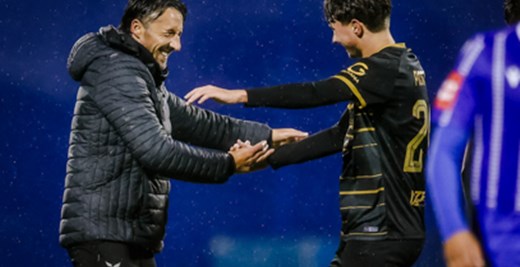
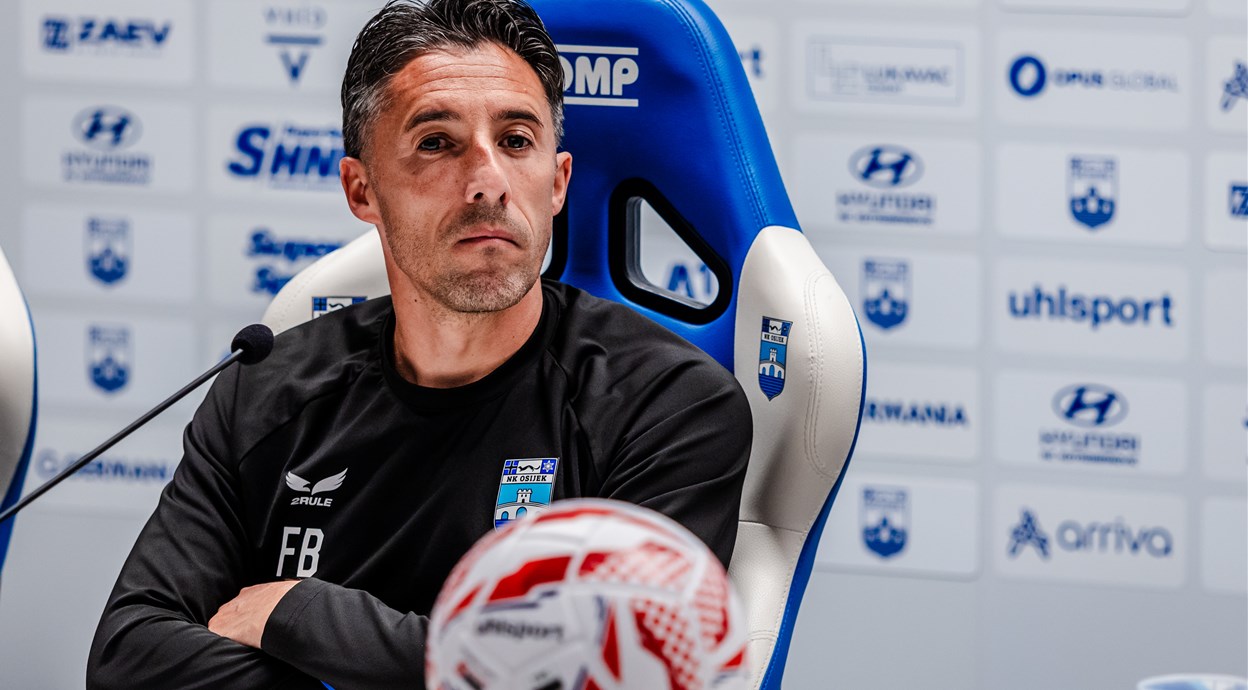
Ahead of Sunday's match against Hajduk, the White and Blues' head coach insists he will not change his style of play, even against the league leaders.
NK Osijek’s players and coaching staff will host Hajduk in a very positive atmosphere on Sunday, 8 November, at 3 PM at Opus Arena. The win over Lokomotiva in Zagreb has contributed to this, although head coach Federico Bessone points out that everything was in perfect order even before that.
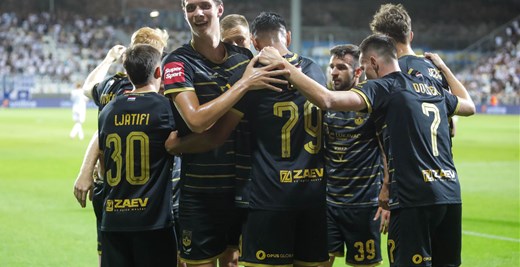
The atmosphere is always good here. Of course, winning and losing are not the same, but we are always positive, starting with me, through the coaching staff and down to the players. It’s logical that the win over Lokomotiva has made the atmosphere even better, but I think we had good games before that too; we just maybe didn’t get the result we deserved in every one of them. As for the injured players, some of them have returned to training, but we have to be careful and see which of them will be ready for the match, said Bessone.
Bessone is not one of those coaches who never change a winning team:
No, that’s not how I work. At the beginning, I spoke with the President and she asked me why I change players who played well for me in the previous match. I told her I do it for tactical reasons. Sometimes other individual qualities are more important to me for what we want to do on the pitch. It’s true that we are missing some important players, but that gives a chance to those who perhaps weren’t in the spotlight before, and now they are proving they are ready to play.
Ready for both scenarios, delighted for Leon
Bessone watched Hajduk’s European match in Gibraltar. What kind of opponent does he expect on Sunday?
I’ve also followed Hajduk’s other matches. I think we’ve prepared very well for Sunday. What I can tell you is that we will give everything we have, we will fight like lions and we will try to give our fans those three points. We all know how Hajduk play with Šego: it’s a high press. And when Livaja is on the pitch, it’s a completely different way of playing, both with and without the ball. We’ve prepared for both scenarios, and I can tell you the lads are fully ready.
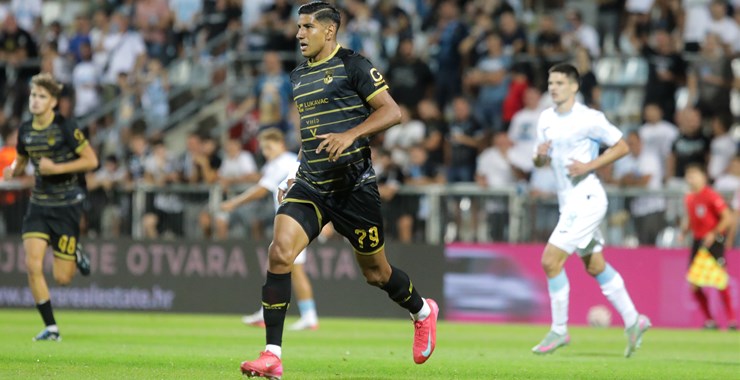
An additional reason for satisfaction at Opus Arena is Armando Leon’s call-up to the Mexico national team.
Armando is not only a great professional; he gives absolutely everything in every match and every training session. On top of that, he’s a truly wonderful person, so we are all thrilled for him. The team embraced him from the moment he arrived. There is something of a language barrier, he’s still working on his English, but he’s trying hard to adapt, so the lads are really happy for him. I think it’s also very significant that he wasn’t called up by some small national team, but by Mexico, which is a huge achievement for the Club, and especially for Armando.
Pressing and looking for space towards the opponent’s goal
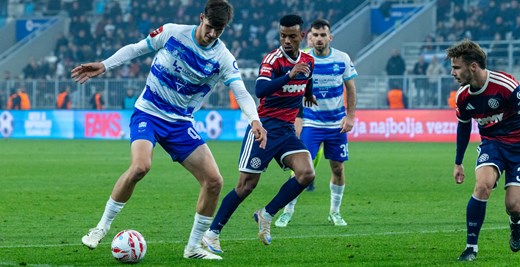
Although the league leaders are coming to visit the White and Blues, our head coach does not intend to change anything in his tactical approach.
As I’ve already told you, we won’t change our style of play. We never change it, so we will press and fight. I think that with this style we’ve created a lot of chances in every match so far. On Sunday, there will be two very good teams on opposite sides. I like how their coach Garcia works and thinks, and how they play. I think he’s one of the best coaches in the HNL. I expect an evenly matched game, because both they and we like to have a lot of possession. We will press and look for the space where we can break through the opponent and score.
Can Osijek return to the home form they showed before October?
We’ll try to be successful at home again, as we were until the defeat to Istra. With the win at Maksimir we got our confidence back, the lads started believing in themselves and in our style of play again, and if we play like we did in the first half against Lokomotiva, I think we have a great chance of winning on Sunday. We expect attacking football from both teams, and I think we have enough character to show our fans, and the visiting supporters too, what we are capable of.
Journalists were also interested in whether 16-year-old Izak Ježić could step in as a defensive midfielder…
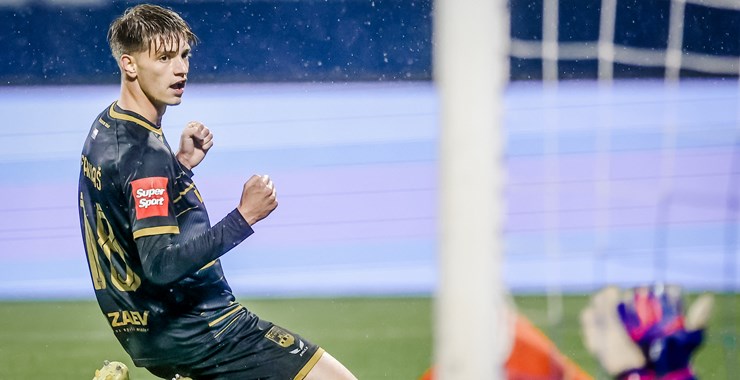
I talk to my colleagues from our Academy all the time, and they explained to me that Izak used to play as a number six, but honestly, I don’t see him in that position in my system. It’s true that he can run a lot, he’s quick and good on the ball and likes to push forward, but he doesn’t yet have that elegance and doesn’t read space as well as, say, Vrbančić. So with me, he will stay at centre-back. I’m very pleased with how Kolarik is playing. He’s back mentally. You have to understand that these are still very young lads, and all that talk about Dinamo and Porto may have distracted him a bit, but now he’s fully focused again. We’re helping him, and I think he’s completely ready and able to play.
The coach wants to pass his mentality on to the team
How much do the Dalmatian mentality and temperament represented by Hajduk differ from our Slavonian, Osijek mentality on the pitch?
I think the coach has a bigger influence on a team’s mentality. When you look at Osijek, where would you say we are from? I simply want to create an identity for the group I lead. When we don’t have the ball, we have to be aggressive and show character. And when we have it, we have to finish our attacks and score goals, and of course not give our opponents a chance to counter. You know yourselves that I’m a temperamental coach, and I want to awaken that mentality in the players as well.
Jelenić’s performances this season have not gone unnoticed by the reporters who follow NK Osijek either, and Bessone agrees that he is one of the White and Blues’ pillars.
Since I arrived, he has really followed everything and stuck to my ideas. He has the character and quality to translate what I tell him onto the pitch, and it’s very important to have a player like that in the dressing room too, because he sets an example for the younger lads as a great professional and an excellent person. He always understands what is expected of him and gives absolutely everything on the pitch. Last season, he always asked to be substituted after 70 minutes; he couldn’t go on. Right at the start, I told him it wouldn’t be like that anymore and that we would only take him off because of an injury or the risk of a card. It was actually a mental block, so we managed to work on that too, and now he can play even 100 minutes if needed, and at a very high level, concluded Bessone.